
Native LaTeX math typesetting.
Real glyph shapes and TeX metrics read straight from the font’s OpenType MATH table — following Knuth’s Appendix G. No MathJax, no KaTeX, no WebView, and no third-party Swift dependencies.
A Swift package for Apple & Linux — and, through one portable display-list seam, native rendering on Windows (WPF & WinUI, from NuGet), Android, and WebAssembly. Not shipping Swift? Render to self-contained SVG or PNG too.
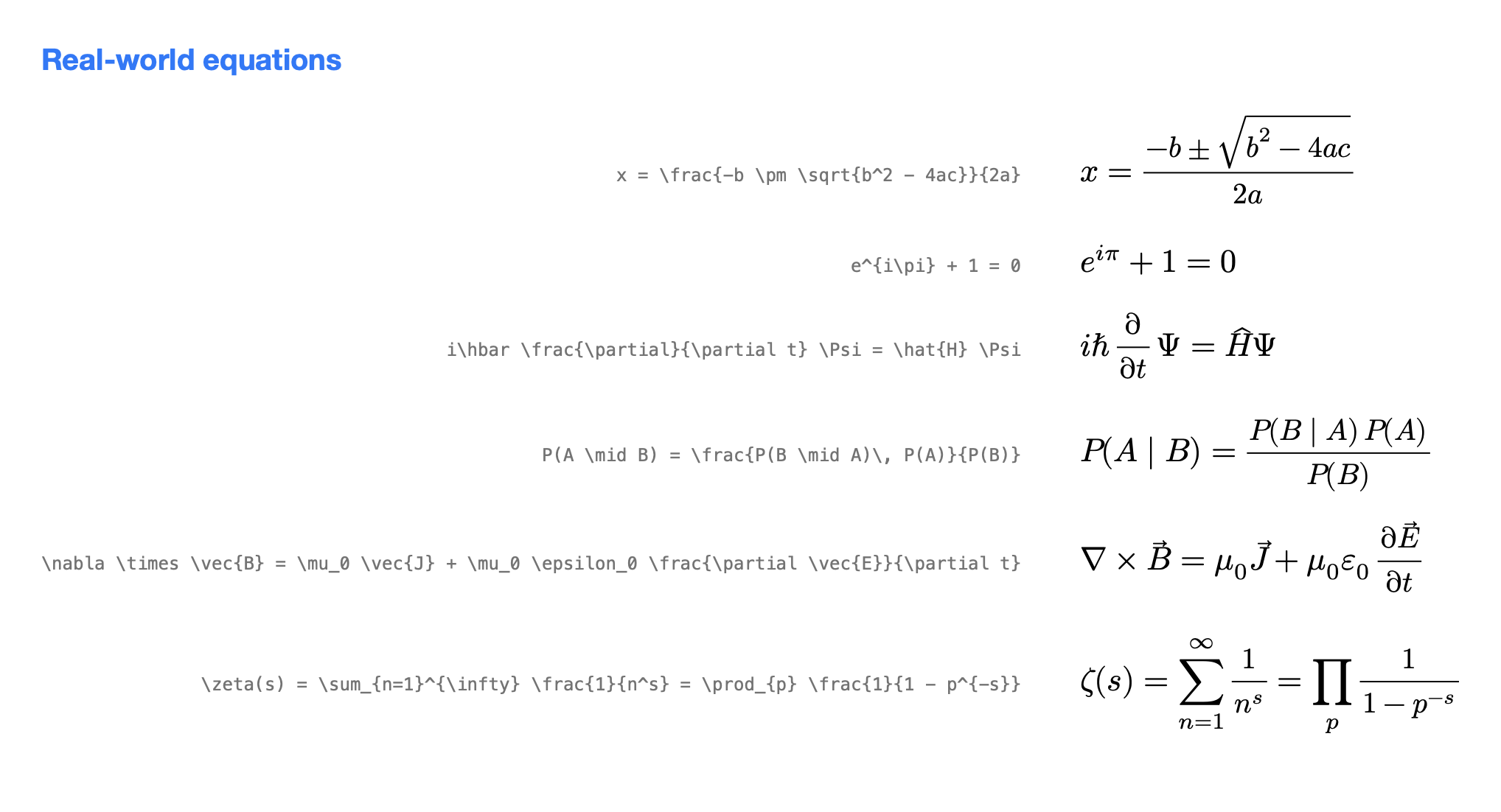
Runs where you do
The layout engine is platform-free, so the same typesetting drives every target.
Apple platforms
macOS · iOS · visionOS · tvOS. Draws with OS-provided CoreText/CoreGraphics — nothing else linked — into a baseline-aligned NSTextAttachment, SwiftUI MathView, or VinculumLabel.
Linux & server-side
Native PNGs via Silica/Cairo + FreeType, behind the opt-in LinuxRaster trait — or self-contained SVG, which needs neither. Default builds stay dependency-free. LINUX.md ↗
Windows & .NET
Native rendering through the C ABI + FreeType, drawn with SkiaSharp. A drop-in VinculumMathView control for both WPF and WinUI 3, shipped as self-contained NuGet packages. windows/README ↗
Android
The C ABI as a JNI library with a Kotlin VDL1 decoder and Canvas renderer — same Skia as the Windows path, so output matches. On-device rendering proven. ANDROID.md ↗
WebAssembly
The platform-free layout core cross-compiles to wasm32-unknown-wasip1 and renders SVG — a ~9.5 MB module on FoundationEssentials (no ICU), run under wasmtime in CI.
One portable seam
Windows, Android, and WebAssembly all reuse it: a fully-resolved scene crosses the C ABI as the language-neutral VDL1 binary, decoded by Swift, Kotlin, and C# — wire agreement CI-gated. DISPLAYLIST.md ↗
The font is the authority
Everything TeX reads from a math font, Vinculum reads from the font — parsed at runtime, used in layout, tested against the raw table bytes.
Full MATH table
All 56 MathConstants, per-glyph italic corrections and accent attachment, cut-in kerning, the display/text/script/scriptscript style lattice.
Optical scripts (ssty)
Superscripts and deep indices use the font’s purpose-redrawn heavier variants, so shrunk glyphs keep the base text’s weight instead of thinning out.
Variants & assembly
Tall fences and radicals step through size-variant ladders, then glyph assembly from end caps and extenders — constant stroke weight, like TeX.
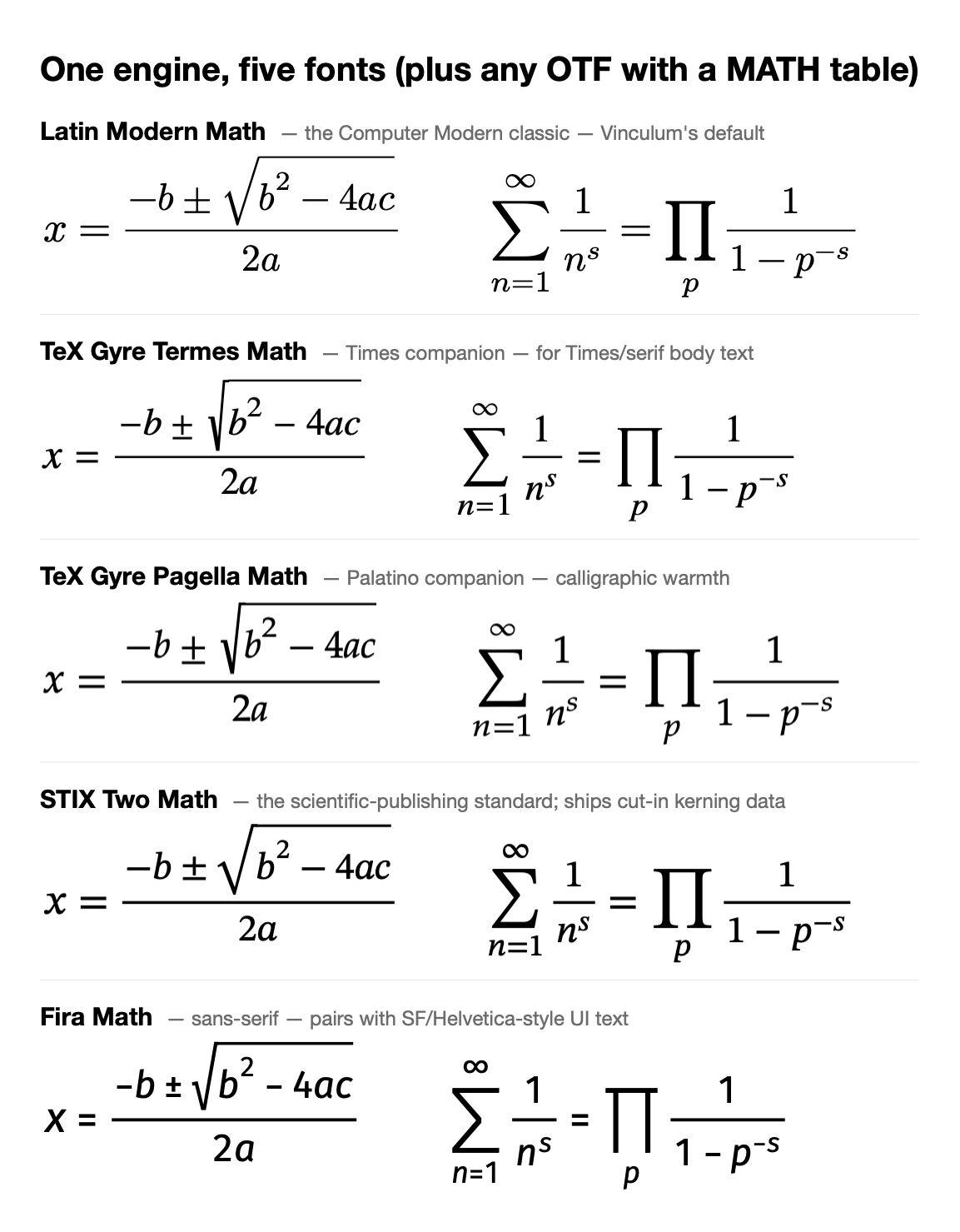
Five bundled fonts
Latin Modern, TeX Gyre Termes & Pagella, STIX Two, and the sans Fira Math — or bring any OpenType MATH font with MathFont(url:).
Spoken math
Every equation carries a ClearSpeak-style description, so VoiceOver reads the mathematics aloud instead of announcing “image”.
Round-trip & hit-testing
MathNode.toLaTeX(), source-ranged parse diagnostics, and an opt-in hit-test substrate mapping points back to the subtree that drew them.
The same equation, two engines
The claim is TeX-grade output — so here it is beside real pdfTeX.
The identical LaTeX through both: Vinculum in Latin Modern, pdfTeX in
Computer Modern (the same lineage). Judge the fidelity yourself.
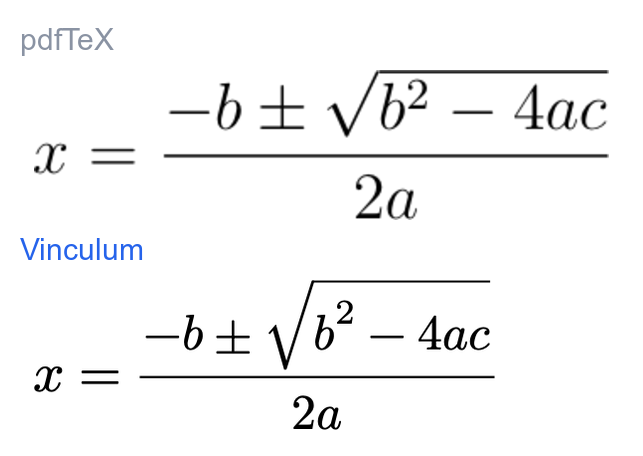
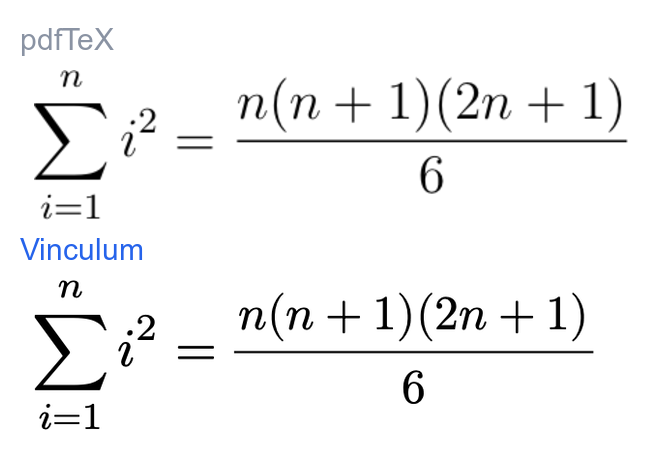
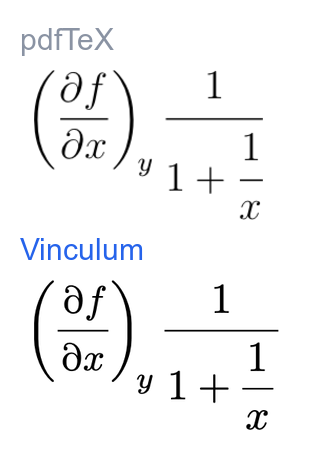
Same LaTeX through both engines, regenerated by scripts/compare-tex.sh — nothing retouched.
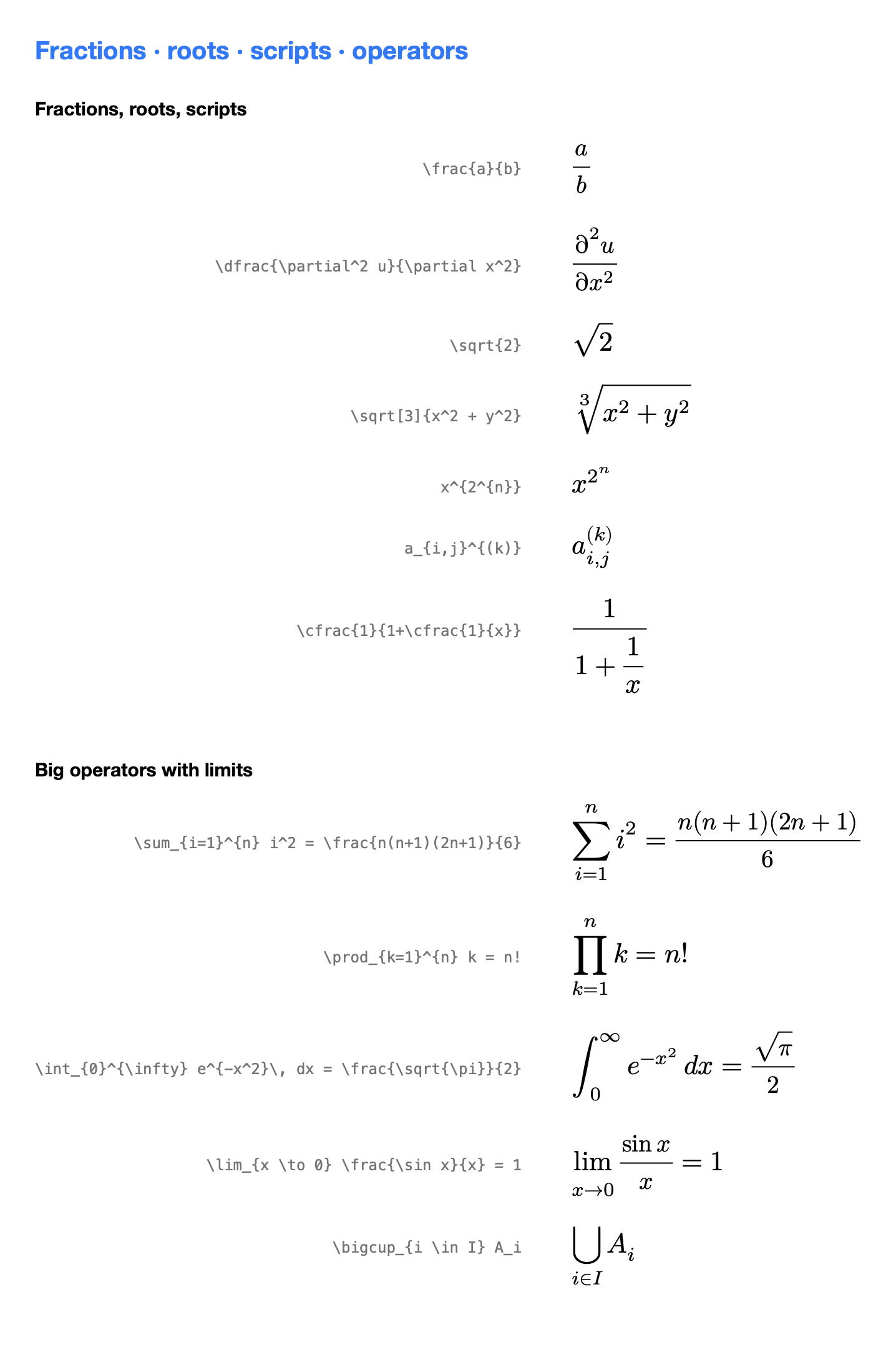
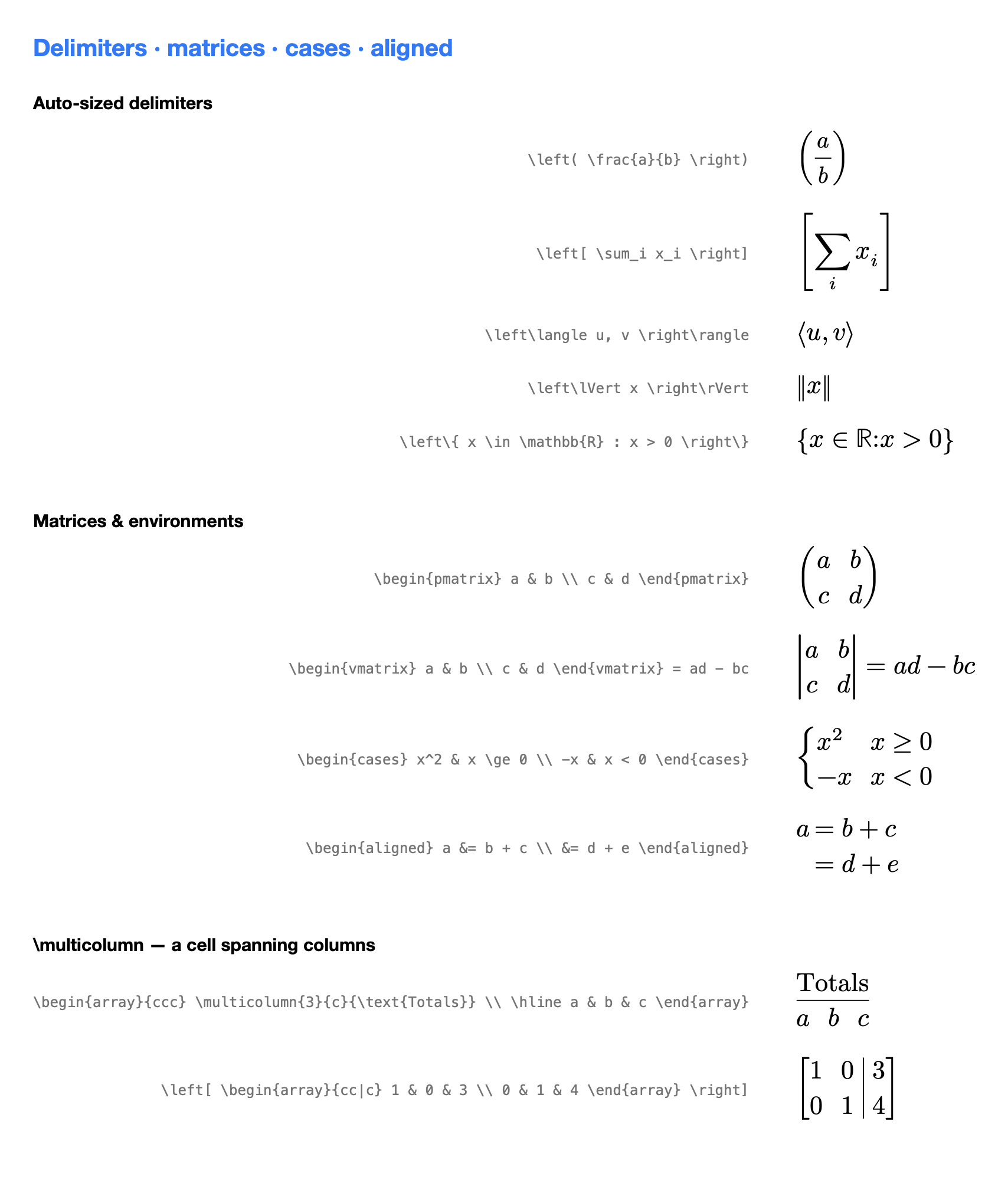
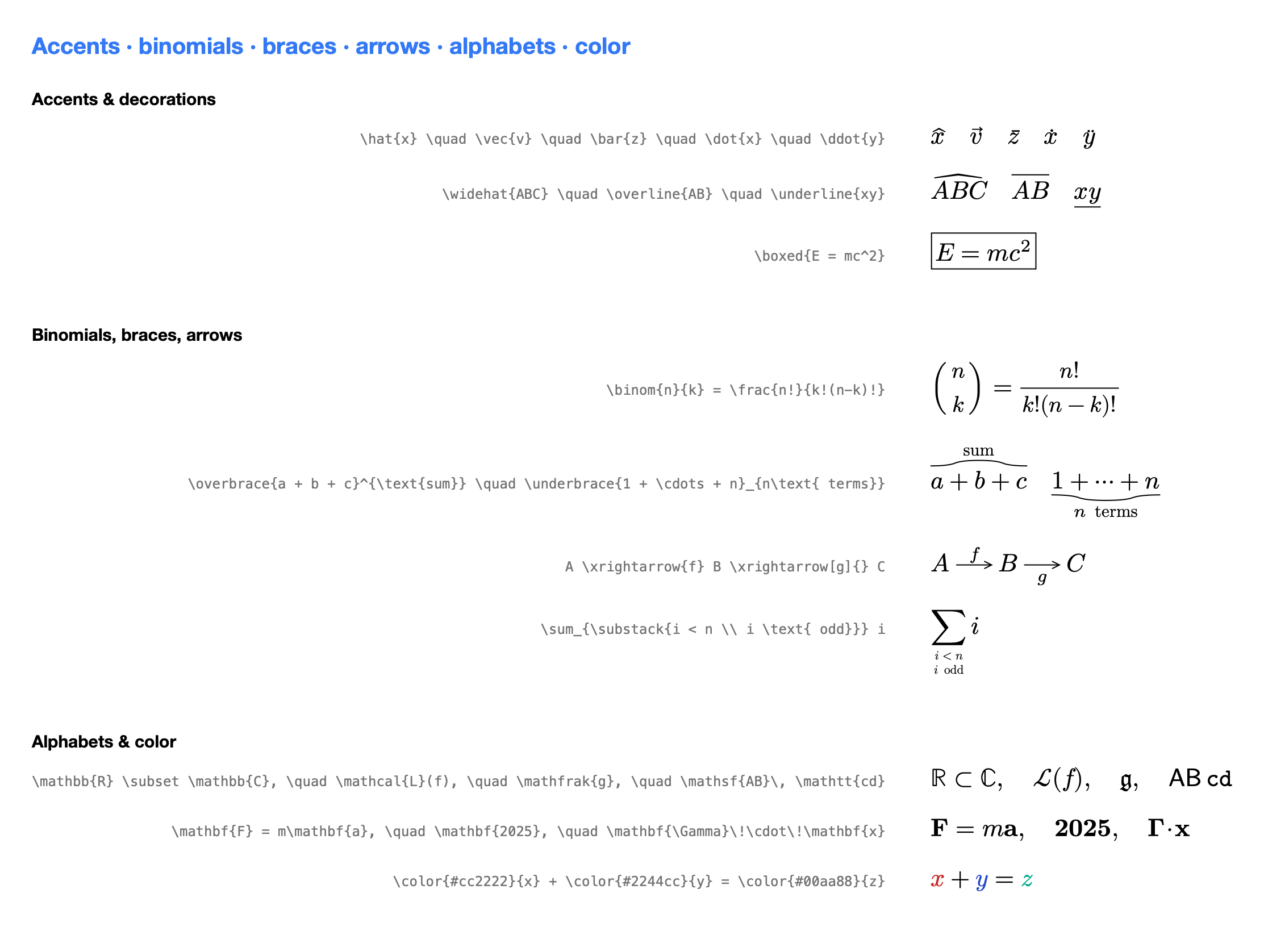
Show, don’t tell
Every image below is regenerated from the live engine on each push — always current, never hand-made.
Every discipline
One engine, one wire format. The same native rendering that draws a fraction
draws chemical equations, physical units, quantum bra-kets, proof trees, and
parse trees — 2D diagrams and all — laid out platform-free and shipped over the
VDL1 display list. Every figure below is regenerated from the live
engine on each push.
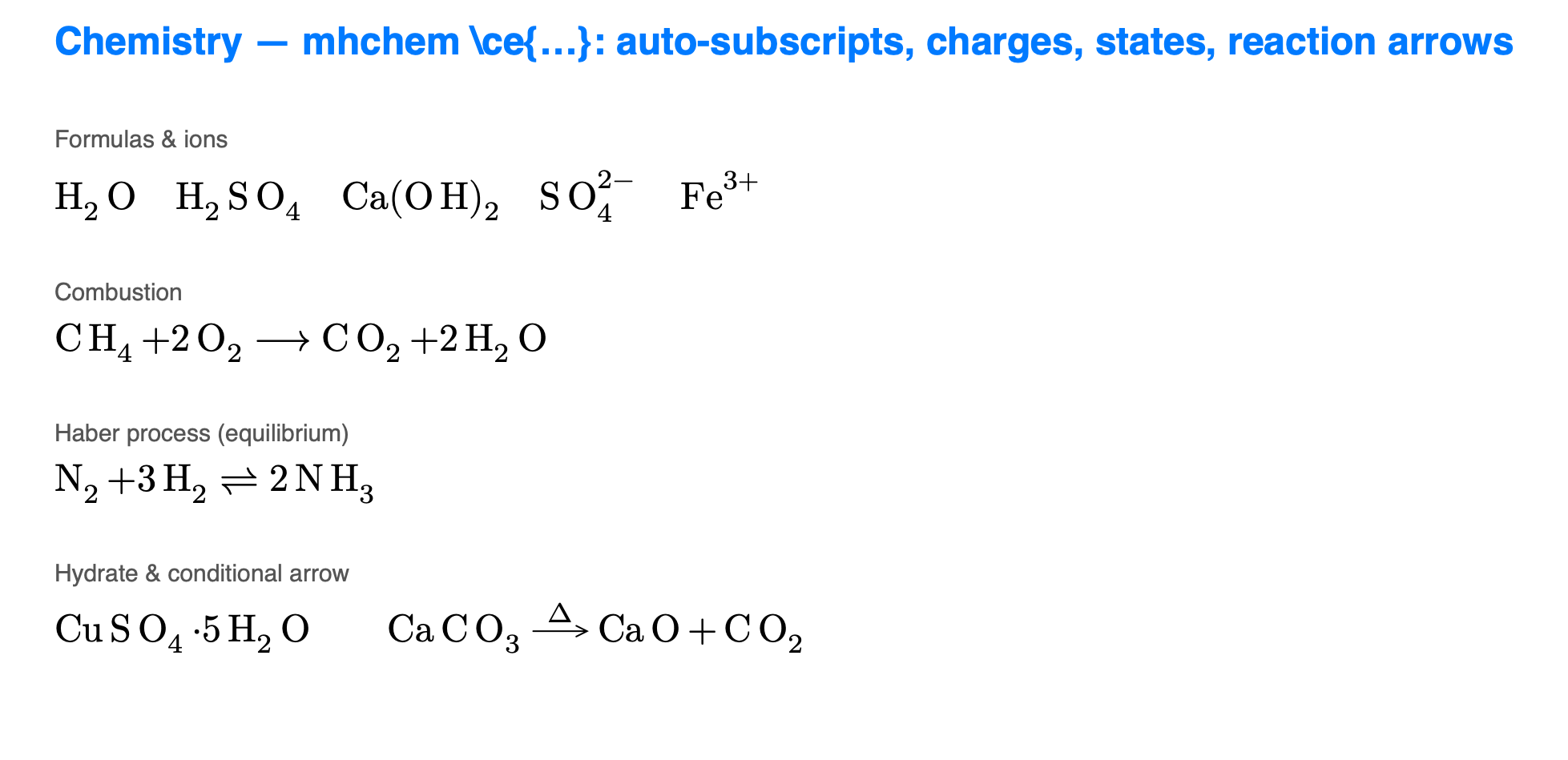
\ce{…}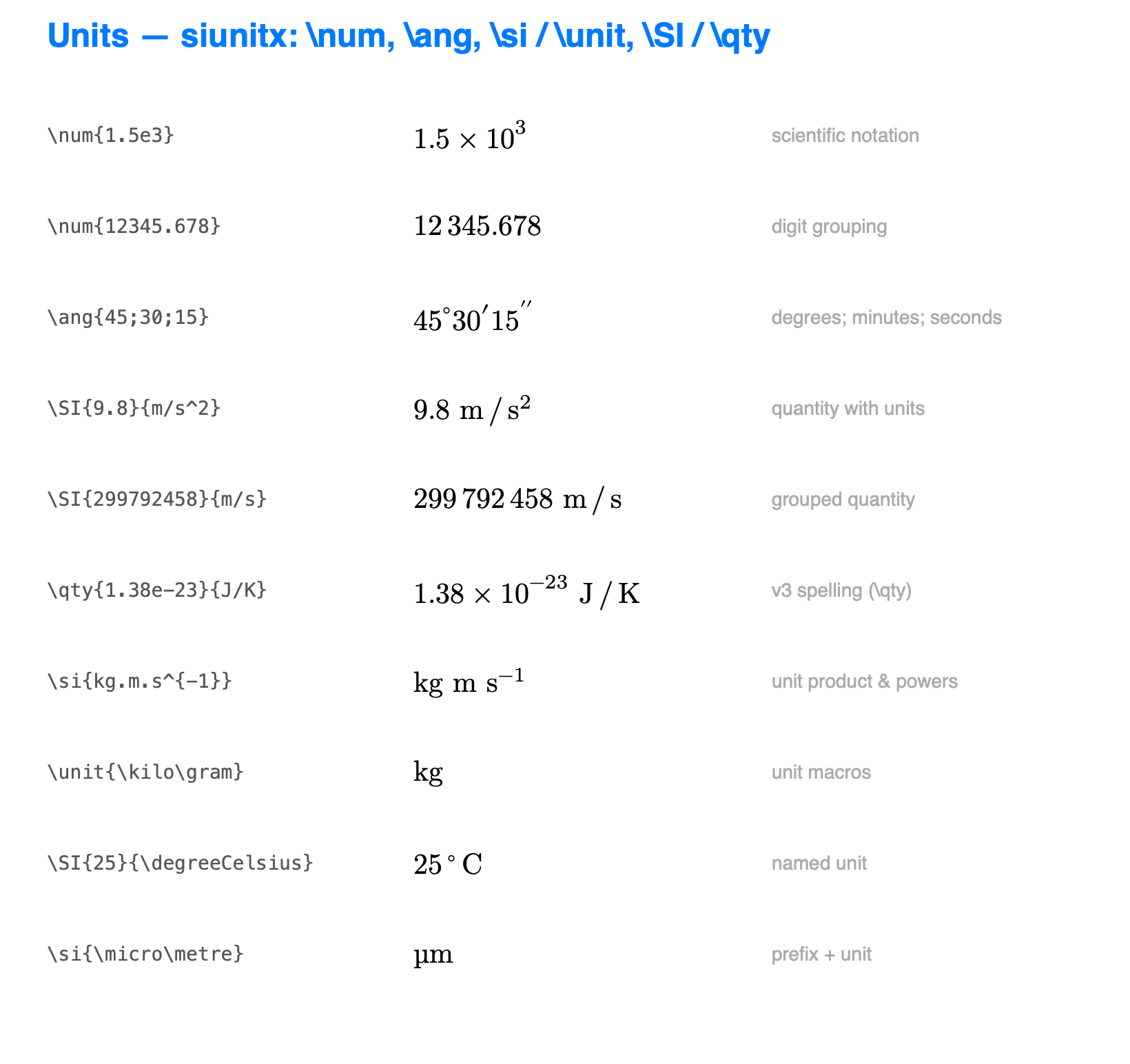
\SI \num \ang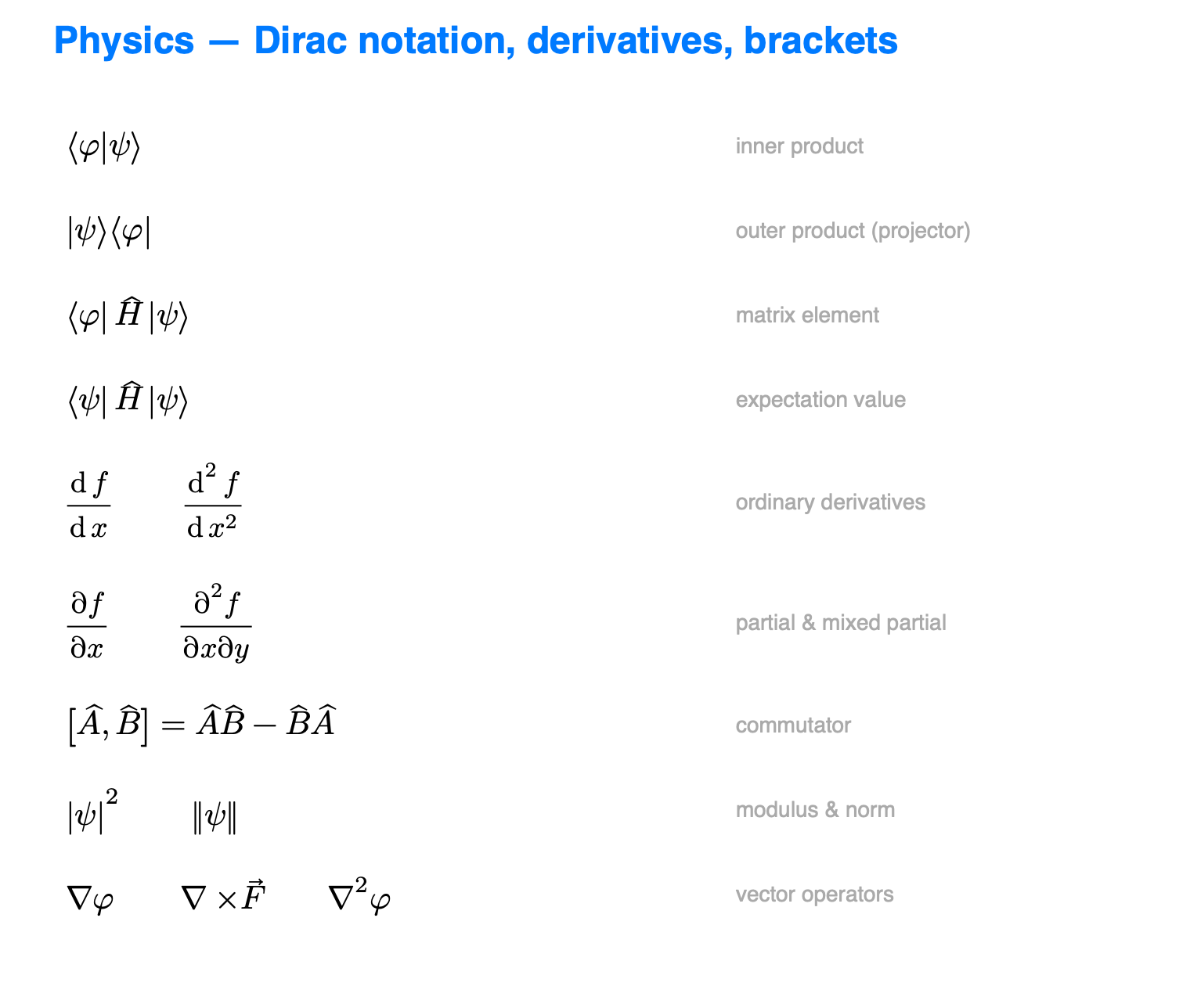
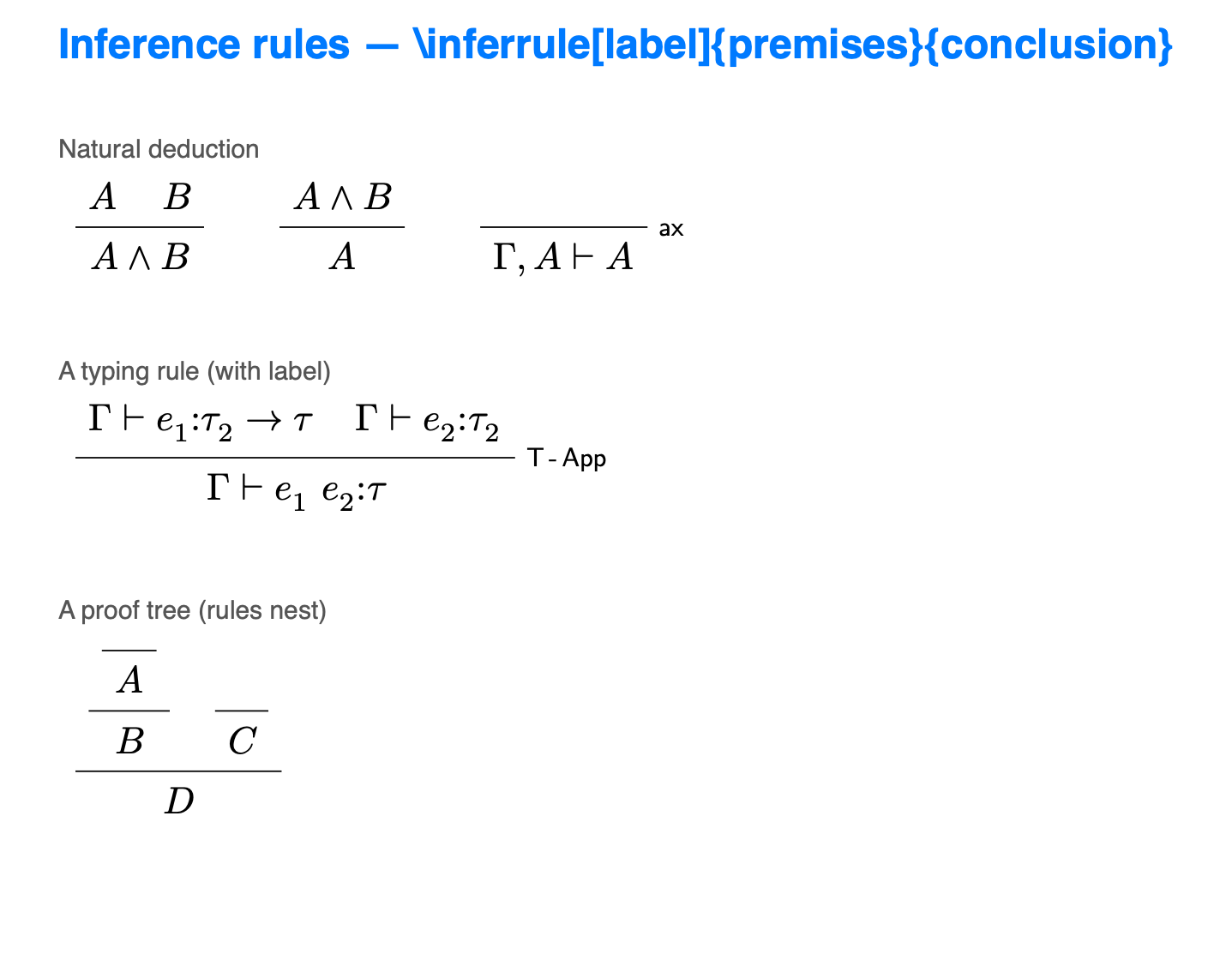
\inferrule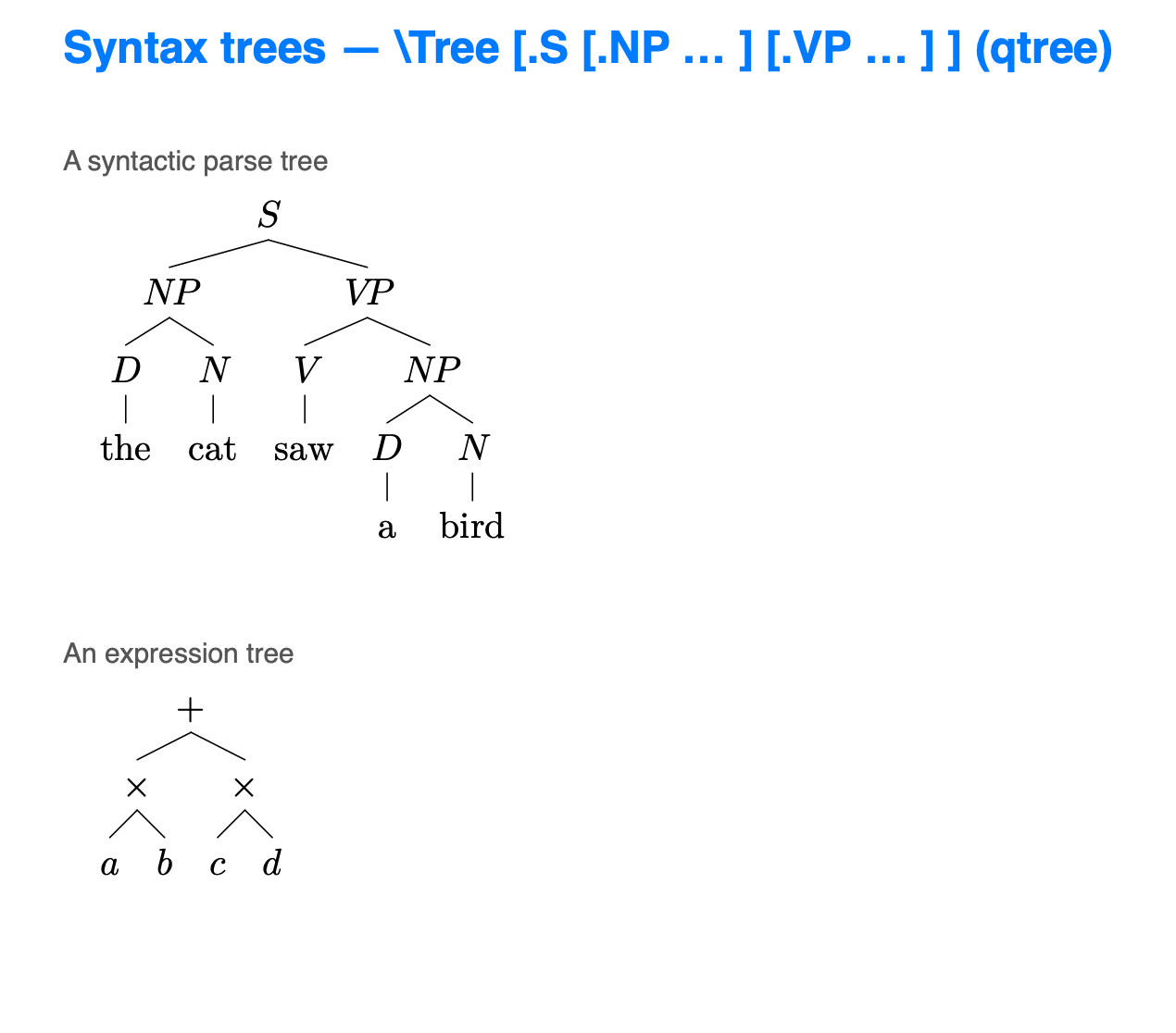
\Tree (qtree)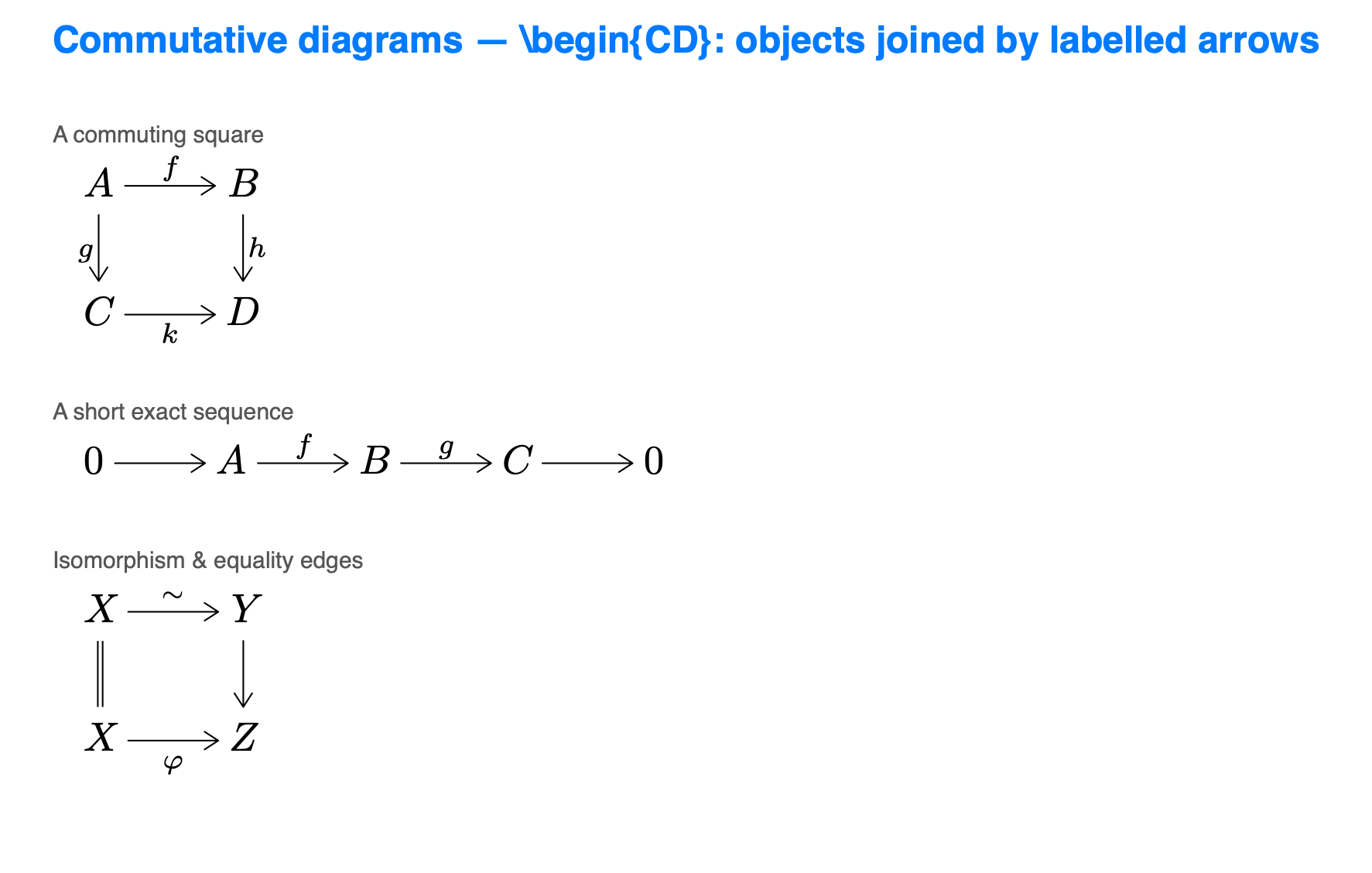
\begin{CD}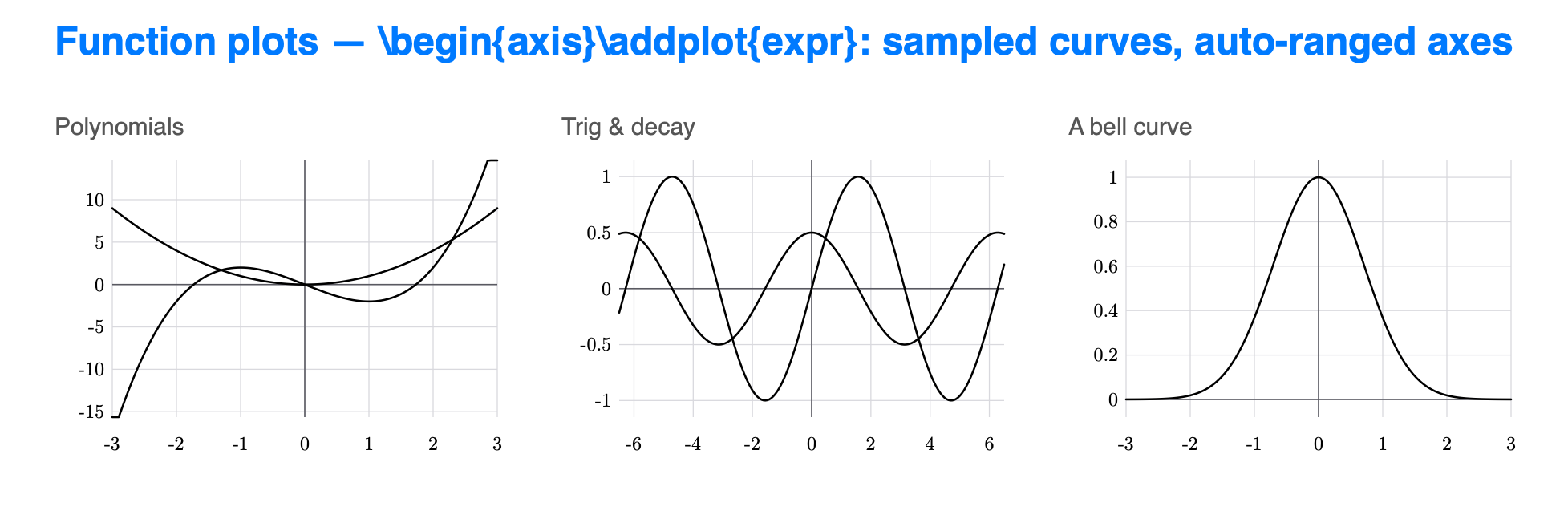
\addplot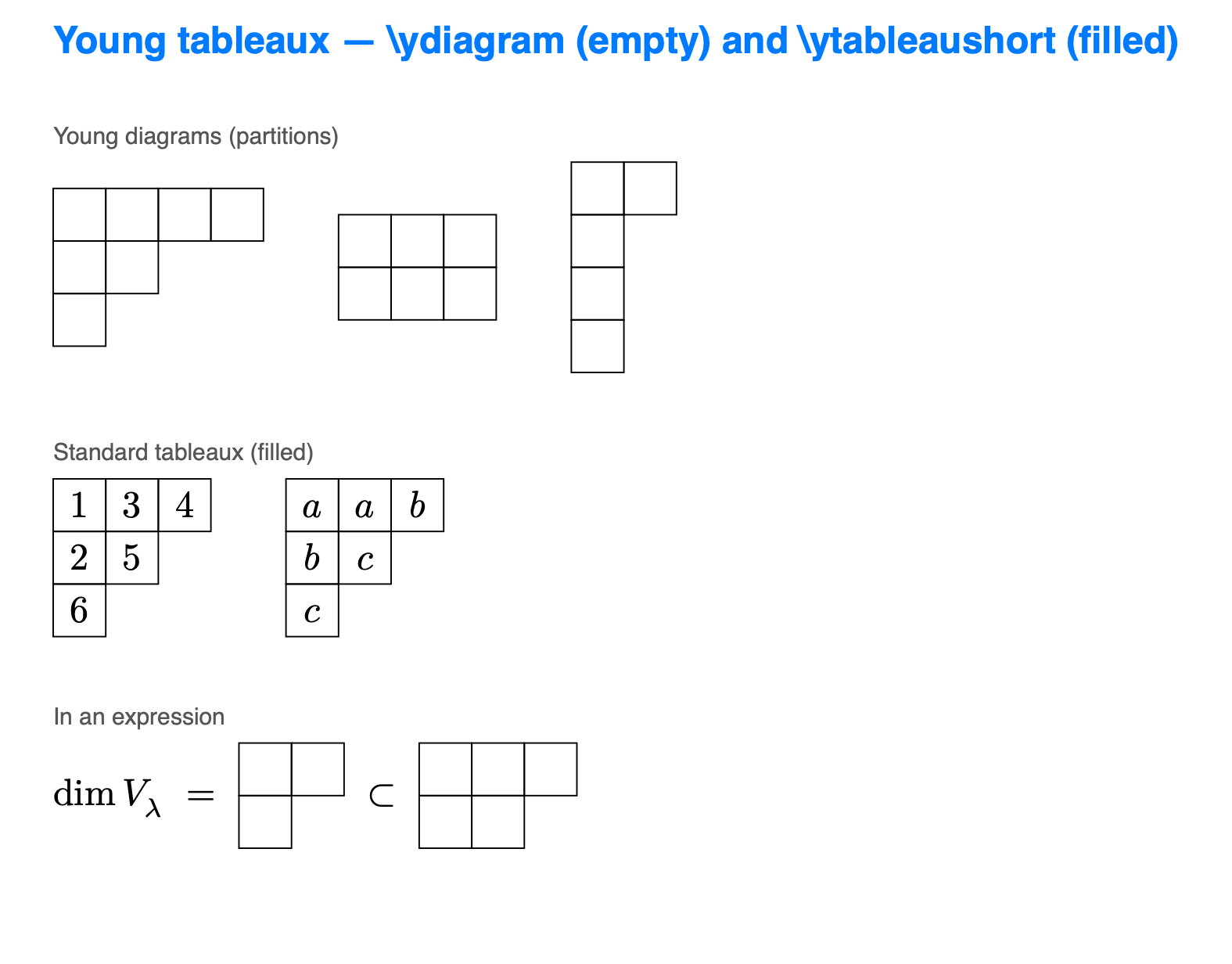
\ydiagramNone of these needs a diagram-specific backend: each is either a transpiler to core LaTeX or a 2D layout emitted as arbitrary paths and glyph runs, so it renders identically on Apple, Linux, Windows, Android, and the web. See the coverage matrix for the full command list.
Fast, and we measured it
No WebView, no JavaScript engine — a cold render is a parse, a dozen CoreText calls, and a draw. We profiled it phase by phase; the full breakdown and methodology are in the report.
~0.5 µs warm
A previously-seen equation is an NSCache hit keyed by content, theme, size, and font — re-rendering costs essentially nothing.
~0.2 ms cold
First sight of an equation: parse → layout → scene. The first on-screen paint adds ~0.23 ms, then the OS caches the bitmap.
~8 µs headless
Pure-Swift layout with no CoreText and no raster — the Linux and SVG geometry path.
~77% is CoreText
Measuring and drawing glyphs — the work any native renderer does. Vinculum's own parse + geometry is under a fifth of the cold path.
Release medians on Apple silicon. Full phase-by-phase breakdown, the deferred-rasterization finding, and debug-vs-release in PERFORMANCE.md ↗.
Built for LLM output
Models emit prose with math mixed in — and, mid-stream, sometimes half-finished LaTeX. Vinculum takes the whole string and does the right thing.
All four delimiters
One call renders a whole response — inline $…$ and \(…\), display $$…$$ and \[…\] — as native typeset math set inline with the prose.
Never a broken render
Malformed or half-streamed LaTeX a model hallucinates degrades to its visible source — a labeled fallback, never a mangled glyph and never a crash.
Spoken, not “image”
Every rendered equation carries a ClearSpeak-style description, so assistive tech reads the math aloud instead of announcing “image”.
Get started
Add the package, then render — one call turns a whole document, or a single equation, into native output.
Package.swift
// Apple platforms, and Linux layout — a Silica-free graph by default
.package(url: "https://github.com/2389-research/Vinculum.git", from: "1.5.0")
Render a whole document (prose with embedded math)
import VinculumRender

textView.textStorage?.setAttributedString(
    MathText.attributedString(from: modelResponse))   // $…$, $$…$$, \(…\), \[…\]
Or one equation as a baseline-aligned attachment
let run = MathImageRenderer.attachmentString(
    latex: #"x = \frac{-b \pm \sqrt{b^2 - 4ac}}{2a}"#,
    display: true, mathTheme: .light, baseSize: 15)
Unsupported input degrades to visible source — never a broken half-render. See INTEGRATION.md for views, SVG, threading, and caching.
Documentation
The reference set — each doc illustrated with CI-regenerated figures.
Why “Vinculum”?
A vinculum is the bar itself — the line over a fraction, a root, or a repeating decimal. The one mark every math renderer has to get right, and the thing this library is named for. The ⁄ in the wordmark is that bar.